We publish every criterion we use. Which numbers get compared against which ranges, and how points come off — we don't hide any of it. If you don't know the criteria, there's no reason to trust the result.
Recommended ranges by speed band
We set your band from your five-swing average clubhead speed, and compare only against that band's ranges.
| Clubhead speed | Launch angle (°) | Backspin (rpm) | Angle of attack (°) |
|---|---|---|---|
| Under 80mph | 14 – 20 | 3,000 – 4,000 | +2 – +6 |
| 80 – 90mph | 13 – 18 | 2,600 – 3,400 | +1 – +5 |
| 90 – 100mph | 12 – 16 | 2,200 – 3,000 | 0 – +4 |
| 100 – 110mph | 10 – 14 | 1,900 – 2,600 | −1 – +3 |
| 110 – 120mph | 9 – 13 | 1,700 – 2,300 | −1 – +2 |
| 120mph and up | 8 – 12 | 1,500 – 2,100 | −1 – +2 |
You'll see the recommended launch angle and spin come down as speed goes up. With enough ball speed it pays to launch lower and let it run, while at slower speeds you have to get it up and gain distance through hang time.
How far outside the range you are changes the judgment. A little outside is caution; 3 degrees or more on launch angle, 600rpm or more on spin, or 2 degrees or more on angle of attack counts as critical.
Strike quality (smash factor)
- 1.48 or higher — good. You're striking steadily near the center of the face
- 1.40 – 1.47 — caution. Adjusting shaft length or weight, or grip size, may help
- Under 1.40 — critical. Your impact point is well off center, so energy transfer is inefficient
Even on a device that doesn't show smash factor on screen, it's calculated exactly as ball speed ÷ clubhead speed, so we fill it in automatically.
How the FIT SCORE is calculated
We start at 100 and add or subtract for each item. The key point is that the size of the change depends on whether the cause is equipment or the swing. This score isn't a "swing skill score" — it's "does the shaft you're using suit your swing".
| Judgment | Equipment problem | Equipment + swing | Swing problem |
|---|---|---|---|
| Critical | −16 | −12 | −7 |
| Caution | −7 | −5 | −3 |
| Good | +3 | +2 | +2 |
That's why a badly out-to-in club path only costs −7. That isn't something you fix by changing the shaft, it's something you fix with lessons. A badly short launch angle, on the other hand, is −16, because loft and kick point can actually move it.
The total is clipped to a 20–100 range. The grades are 85 and up a very good match · 70 and up a decent match · 55 and up room for improvement · under 55 worth looking at a change.
We look at shafts on five axes
- Weight — heavier gives direction and stability, lighter gives speed. Frequent mishits or wandering direction point heavier, short distance points lighter, as a general direction
- Stiffness (flex) — matched to your clubhead speed and how sharp your transition is. Too soft and the face arrives closed; too stiff and the ball won't get up and leaks right
- Kick point — where it bends. A low (tip) kick raises the flight; a high (butt) kick lowers it. It's the first thing we look at for someone short on launch angle
- Torque — resistance to twisting. Lower means the face turns less at impact, so direction steadies, but the feel gets firmer
- Length — longer picks up speed but costs strike quality. A low smash factor makes us suspect length
The analysis decides for each of these five whether it should go up or down from where you are now, and then finds the shafts in the catalog that fit that direction. If you use the stock shaft, picking the head model and flex is enough — we fill in the weight from the registered stock spec.
We look at CPM rather than flex
There isn't one S flex in the world. Makers use different standards, so it's common for one company's S to be softer than another company's R. That's why choosing by the label alone misses.
CPM (cycles per minute, frequency) is the number of times a shaft oscillates per minute when it's clamped and plucked. It's a measurement, so it compares across makers. The lower it is the softer the shaft, the higher the stiffer. That's why a fitting studio has a frequency meter.
This is the real reason to look at CPM. Every 0.25 inch of extra club length makes it play about 1.7 CPM softer. An S flex built to 46 inches is 3 CPM softer than the same S built to 45.5 inches. The flex label is unchanged, but what you feel when you hit it isn't.
So OhMyShaft doesn't just tell you a recommended flex; it also shows the target CPM calculated for the club length you entered. The photo-based Full Analysis uses the length you enter, and the Quick Check uses the standard 45.5 inches.
Reference frequency by flex
These are the reference values for a build at the standard driver length of 45.5 inches.
| Flex | 44.0" | 45.0" | 45.5" | 46.0" |
|---|---|---|---|---|
| L (ladies) | 206 | 199 | 196 | 193 |
| A (senior) | 219 | 212 | 209 | 206 |
| R (regular) | 233 | 226 | 223 | 220 |
| SR | 243 | 236 | 233 | 230 |
| S (stiff) | 253 | 246 | 243 | 240 |
| X (extra stiff) | 273 | 266 | 263 | 260 |
The unit is CPM. The gaps between flexes are narrow at the bottom (L→A 13) and wide at the top (S→X 20). That's why a faster swing feels one step of difference more.
It's a target range, not a right answer. ±5 CPM is a common margin, and the reading shifts by a few CPM with the measuring gear and the clamping method (butt clamp length, tip weight). Measure the same shaft at a different shop and the number can come out a little different.
And our catalog doesn't hold a measured CPM for each product. We only have weight and torque, so we can't tell you "this product is 245 CPM". Taking the target number with you and having it measured when you test a shaft is the sure way.
SR isn't in the original reference table, so we put it midway between R and S. Unlike the other values, it's filled in by calculation rather than measurement.
Where the criteria come from
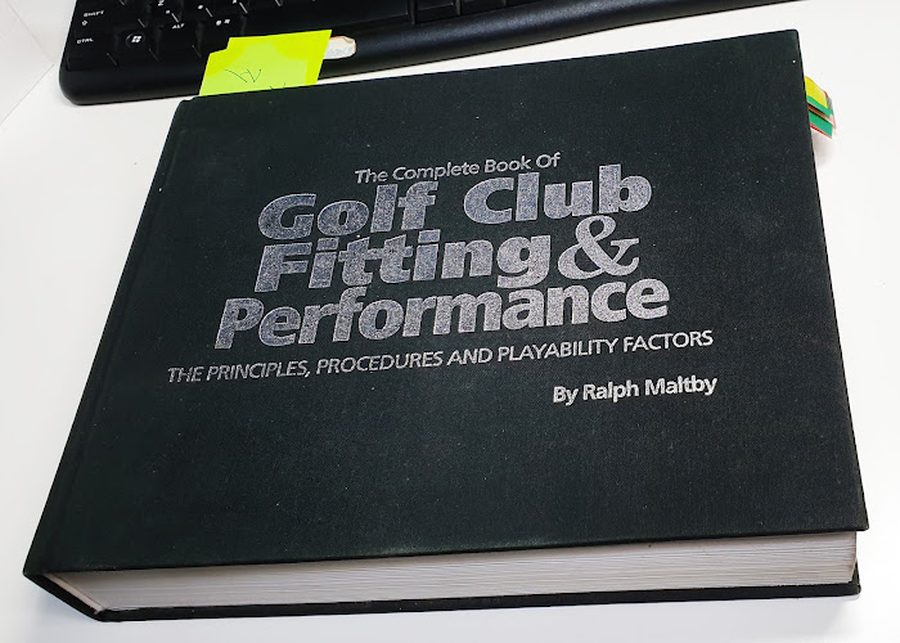
The five axes set out above (weight, stiffness, kick point, torque, length), and the approach of adjusting them to a golfer's swing, are a framework that club fitting has been working out for a long time. Ralph Maltby's The Complete Book of Golf Club Fitting & Performance is a landmark book on that framework, and we referred to it when designing the analysis items.
OhMyShaft is built and run by «Bulpyeonhan Chae Gangta», who loves golf for real. He completed the club fitting course at Fitters Club.
The specific numbers in the table above aren't a table certified by a particular book or organization. They're a summary of the ranges generally used in launch-monitor-based fitting, and that's exactly why we publish the criteria. If an expert sees it differently, they can point straight at what differs and why.
If you disagree with a criterion, tell us. If the reasoning holds up, we'll change it.
For the frequency figures we referred to the Frequency Profile chart from Fitters Club (fittersclub.kr). It's the standard the operator learned while completing the club fitting course there, and the table above reads off the length-to-frequency relationship that chart sets out. We didn't copy the original chart; we rebuilt only the values we needed as a table.
How deep the analysis goes depends on the device
Many of the golf simulators used in Korea don't provide angle of attack, club path, or dynamic loft. Measure on one of those and there is simply less for the analysis to stand on.
In that case the tool leaves a missing value blank rather than estimating it. The result screen shows the real counts as they are, like "○ critical · ○ caution", so you can see how much evidence the analysis rests on and judge accordingly. A photo from a device that gives you angle of attack as well (Trackman, GC Quad, and so on) produces a much finer-grained analysis.